
Imagine picking grapes from a vine you planted yourself, in your own garden, with your own hands. Not just any grapes, but a fruit that embodies patience and care, a fruit that tells a story that began with a tiny seed you buried in the soil. Growing grapes from seed is not an easy journey, but it is undoubtedly rewarding for any home gardener who seeks the challenge and joy of watching life emerge from beneath the soil.
Whether you're in Taif, renowned for its high-quality grapes, or Tabuk, the grape-producing capital of the Kingdom, or any other region of Saudi Arabia, this journey begins with well-thought-out steps and patience. In this comprehensive guide, we'll take you step-by-step through the process of growing grapes from seed, the optimal planting time, and tips specific to Saudi Arabia's climate, transforming your dream into a fruitful vineyard in your home garden.
Why choose to grow grapes from seed?
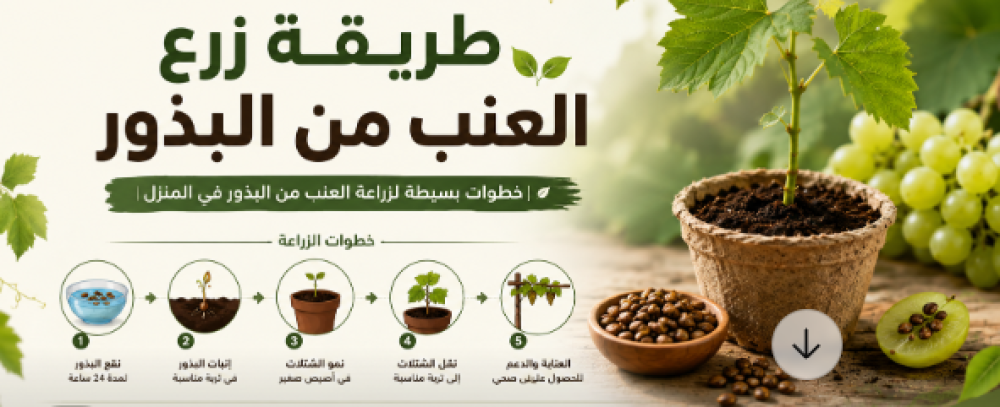
Before we delve into the details, let's be honest. Growing grapes from seed isn't the fastest, nor the most reliable, method. It's a journey that requires patience and can last three years or more before you see your first fruit. But the reward is priceless: a tree that carries your genetic imprint, fruit that may be unique in its taste, and an unparalleled learning experience. Here's a summary of how to grow grapes from seed in 5 steps:
- Choose the right seeds from fresh, healthy grapes.
- Clean and soak the seeds to remove any remaining pulp.
- Stratification (cooling) in the refrigerator to simulate winter (mandatory step).
- Germination in a warm, moist environment using a tissue or cotton.
- Planting in suitable soil and taking care of the seedlings until they are ready for transport.
Phase 1 – Selecting and preparing the seeds (the first step towards success)
Your success begins here. Choosing the right seeds is the cornerstone of a strong and resilient seedling.
Choosing the right variety: between red and sectarian
Saudi Arabia is fertile land for many varieties of grapes. Among the most famous are the Taif white (Bayad) and black (Sawadi) grapes, as well as the Hijazi, Halwani, Red Roumi, Sharifi, Shah, Khalili, and Banati varieties, which are distinguished by their intense sweetness and small, seedless berries. When choosing grape seeds, consider the variety best suited to your region's climate. Using seeds from local grape varieties that have adapted to the local environment is preferable for greater success. This is where Al-Talib Store comes in, offering seeds tested for resistance to local heat.
Buoyancy test: How to differentiate between viable and hollow seeds?
Not all that glitters is gold, and not every seed is suitable for planting. To test the viability of grape seeds, do the following:
- Place the seeds in a glass of water.
- Wait a few minutes.
- The seeds that sink to the bottom are the healthy and viable seeds.
- Seeds that float to the surface are hollow or damaged seeds and should be discarded.
Cleaning and drying: Protecting seeds from fungi
After selecting healthy seeds, they must be cleaned very carefully. Wash them with lukewarm water to remove any remaining pulp or juice, as this residue provides a breeding ground for fungi and mold that could kill the seed before it germinates. Dry the seeds on a clean paper towel for a few hours.
Stage Two – The Secret of Cooling (Layered Division)
This is the most important and often overlooked step by beginners. Without it, grape seeds may never germinate.
What is stratification (cooling)?
In nature, grape seeds fall in autumn and remain dormant in the cold soil throughout the winter. This cold and moisture break the seeds' dormancy and prepare them for germination in the spring. Stratification is a simulation of this winter in your home refrigerator.
Cold processing step by step
- Get a paper or cotton towel, and wet it with water (not dripping wet, just damp).
- Spread the seeds over the moistened tissue, leaving small spaces between them.
- Fold the napkin over the seeds, then place it inside a tightly sealed plastic bag.
- Write the start date on the bag, then place it in the vegetable drawer of the refrigerator (temperature between 1 and 3 degrees Celsius).
- Leave the seeds in the refrigerator for two to three months.
- Check the paper towel every two weeks and make sure it stays moist. If you notice any signs of mold (white fluff), discard the affected seeds and change the paper towel.
Third stage – germination and cotton method
After the cooling period is over, it's time to wake up the seeds.
Handkerchief vs. cotton: Which is better?
Both methods are good. Paper towels are lightweight and easy to use, but cotton retains moisture better for longer periods. In our dry climate, cotton may be a safer option.
Al Talib Store Tip : Use clean medical cotton to increase your chances of success.
The ideal temperature for germination
Remove the bag from the refrigerator and place it in a warm spot. The ideal temperature for germination is between 20 and 25 degrees Celsius during the day and 15 degrees Celsius at night. You can place the bag near a sunny window, but away from direct, intense sunlight.
Early mold treatment
If you notice white fluff appearing during this stage, it means the humidity is too high. Open the bag slightly to ventilate the seeds, and transfer them to a clean, dry (moisten) paper towel. You can also lightly spray the seeds with a diluted hydrogen peroxide solution to prevent fungal growth.
When will you see the sprouts? Germination can take anywhere from two to eight weeks. Patience is key here.
Stage Four – Soil Cultivation
When the small root (cotyledon) appears from the seed, it is time to plant it in the soil.
Choosing the right soil
Grapes don't like heavy or clay soils that retain water for long periods, as this leads to root rot. They need well-draining soil rich in organic matter. Make a mixture of peat moss, perlite, and vermiculite, or use a ready-made, sterilized mix from a student store to ensure a healthy, disease-free start.
Choosing pots: good drainage and appropriate size
Choose small pots with a diameter of 10-15 cm, and make sure they have drainage holes in the bottom. This protects the young roots from becoming waterlogged and rotting. Clay pots are an excellent choice as they allow for good root aeration.
Planting depth: Avoid the fatal mistake
Plant the seed no deeper than twice its own size (approximately 1.5 to 2 cm). Planting too deeply depletes the seed's energy and prevents it from reaching the surface, causing it to die. After planting, lightly water the soil.
Fifth stage – Seedling care in the Saudi climate
Grape seedlings are very sensitive in their first stage, especially in our hot climate.
Sunlight management: Protection from the midday sun
Young seedlings need sunlight, but the intense midday sun in Saudi Arabia is harmful to them. Place the pots in a location that receives morning sunlight and is shaded during the afternoon (use shade netting or place them under a tree). Mature grapevines need 7-8 hours of sunlight daily, but seedlings require a gradual transition to higher temperatures.
Irrigation schedule: delicate balance
Water the seedlings when the soil surface feels dry. Constant moisture does more harm than good. The best way to water is from below by placing the pots in a saucer of water and letting them absorb what they need, or by carefully watering around the seedling and not directly on the stem to avoid soil-borne diseases.
Fertilization (NPK): When do we start?
Seedlings do not need fertilizing during the first month. After the first two true leaves appear, you can begin very light fertilizing using a balanced fertilizer diluted (equal parts NPK) to half or a quarter of the recommended concentration. Avoid over-fertilizing as this can burn the young roots. Start with liquid organic fertilizers for safe results.
Troubleshooting Common Problems (Quick Rescue Guide)
Why are the leaves turning yellow?
This is a common question among beginners. Yellowing leaves have two main causes:
- Overwatering: The roots become submerged and cannot absorb nutrients, causing a general yellowing of the leaves.
- Nutrient deficiencies: especially iron deficiency (yellowing between leaf veins) or nitrogen deficiency (yellowing of the lower leaves first).
Solution: First, check the soil moisture and adjust the watering schedule. Then, consider a light, balanced fertilization.
Sudden death of seedlings (death of seedlings)
You wake up in the morning to find your little seedling lying on the ground as if someone had cut it at the base. This is fungal damping-off disease.
- The cause: soil fungi, often caused by poor drainage and high humidity.
- Prevention: Use sterilized soil, avoid overwatering, and ensure good aeration. If it does occur, saving the seedling is difficult, but you can prevent it in future attempts by using specialized soil mixes.
Home garden pest control
Small insects such as aphids or mealybugs may appear. Initially, you can spray the seedlings with a solution of water and liquid soap (free of harsh chemicals). For more severe cases, consult a student store expert for a safe solution.
Seeds vs. cuttings: Is it worth it?
Growing grapes from seed is tempting, but it's not the only method. Let's compare growing grapes from seed and from cuttings (plantings) to give you a clearer picture:
- Fruiting period: 3 years or more for one year (or less)
- Genetic diversity is significant: it may produce fruit different from the parent fruit, perhaps better or worse, and inherit exactly the same characteristics as the parent fruit.
- It is difficult and requires patience, as well as cooling and special care. The cultivation process is more obvious and successful.
- Economic feasibility: Very low in the short term, but it is an enjoyable scientific experiment, especially if you want a guaranteed harvest.
If you want a guaranteed harvest of grapes with the same qualities you love, choose cuttings. Growing grapes from seed is a journey of passion, experimentation, and creativity, not a quick commercial investment. Expect to grow a unique vine that may be even more beautiful and delicious than you imagine.
Why choose the Student Store for your grape seed planting journey?
Student Store is the best website for buying agricultural seeds, offering you everything you need from the finest types of agricultural seeds in Saudi Arabia . Start your journey in growing grapes from seed with one complete package that includes: selected seeds, sterilized soil, pots, and organic fertilizer. Everything you need is just a click away.
Our seeds are not like any other seeds. We store them to withstand local heat, ensuring the highest germination rate in the Kingdom's harsh conditions.
Our team of agricultural experts is waiting to answer your questions, provide advice, and help you overcome any obstacle you face on your way to your dream vineyard.
Conclusion
Growing grapes from seed is one of the most rewarding experiences for gardening enthusiasts. It requires patience, knowledge, and care, but its reward lies not only in the final fruit but in every moment you witness life blossoming before your eyes. From selecting the seeds, to chilling them in the refrigerator, to the first sprout breaking through the soil, until your little vine is ready to thrive outdoors, you are writing your own success story in the world of home gardening.
Don't hesitate to begin this journey. Patience and perseverance, along with the right tools and support, will inevitably lead you to a vineyard that will shade your garden and bear the finest fruit.
Frequently Asked Questions
Can I grow grape seeds that are available in the supermarket?
Yes, but the chances of success are lower. Commercial grapes are often hybrid varieties, and their seeds may not germinate. Additionally, the seeds may have been heat-treated or harvested before they were fully ripe. For best results, use seeds from fresh, organic grapes, or from reputable sources like a student store.
How long does it take for a grape seed to germinate?
The average time is 2-8 weeks after the end of the cooling period (stratification). If it hasn't germinated after 8 weeks, the seed may be non-viable, or the temperature may not be ideal.
Where can I buy a complete grape growing kit in Saudi Arabia?
At Student Store, we provide everything you need, from seeds and soil to pots and fertilizers, along with ongoing support every step of the way. Your grape-growing journey begins with us.